
Airport and Terminal Flooring: Lounges, Gates, Boarding Bridges and Concourses
October 2026 · 8 min read · by BON Flocked Flooring
The short answer
Zone the terminal before you choose a floor. Main walkways, check-in lanes and baggage reclaim take the heaviest wheeled traffic and are usually hard. Gate seating, lounges, offices and boarding bridges are where people sit and wait, and where a textile floor makes the space quieter underfoot and warmer. Flocked flooring is a dense nylon 6.6 textile surface on an impervious backing: it cuts impact sound (ΔLw 21 dB, ISO 10140-1 / 717-2, SGS), wet-cleans on a night shift, is classified Bfl-s1 for fire (EN 13501-1), has a slip resistance of 0.45 (EN 13893), and can be printed with wayfinding or a design for the place.
What it is not: we do not hold a rolling-load or castor wear test for it, so we do not rate it for trolley lanes; keep those routes hard or ask us for wear data. It does not reduce the echo of a terminal hall, which is a ceiling and wall job. And it is not a floor for baggage halls, kitchens or toilets.
An airport is one building with ten different floors in it. The walkway from security to the gates sees every passenger and every trolley, all day and all night. Twenty metres away, a gate holdroom is a waiting room where people sit for an hour on a hard floor that amplifies every footstep. Specifying one floor for both is how terminals end up either noisy where people wait, or worn where people walk. This guide goes through the terminal one zone at a time, shows how one airport we supplied zoned it, and lists what to put in the tender.
Zone by zone: what each area asks of the floor
| Zone | What the floor has to handle | Flocked flooring? |
|---|---|---|
| Main concourse walkways | The heaviest wheeled traffic in the building, around the clock, and machine cleaning at night. | Usually not. Keep the main circulation routes hard, as the Velana terminal does. |
| Gate seating and holdrooms | Hundreds of people sitting and waiting, children on the floor, spilled coffee, and a big hard room that is loud underfoot. | Yes. This is where it is installed at Velana International Airport. |
| Lounges and VIP areas | Comfort and a premium look, food and drink, long stays. | Yes: quiet and warm underfoot, wet-cleanable, and printable with the lounge’s own design. |
| Passenger boarding bridges | A narrow route used by every passenger, in all weather, with the bridge maker’s own requirements for finishes. | Yes, subject to the bridge manufacturer’s requirements. We have supplied boarding bridges at a major South Korean airport. |
| Check-in and security | Queues, trolleys, frequent cleaning. | Case by zone: queue areas can be textile, trolley lanes usually stay hard. |
| Baggage reclaim | Loaded trolleys, cases dropped from belts, wet coats. | No. Use a hard floor here. |
| Entrances | Rain, grit and wet wheels coming straight in. | No. Use an entrance matting system, then the floor beyond it. |
| Offices, crew rooms, airline back-of-house | Desks and chairs, the same needs as any office. | Yes. See the office flooring guide. |
Back-of-house offices and crew rooms have the same brief as any workplace, covered in the office flooring guide.
How Velana International Airport zoned it
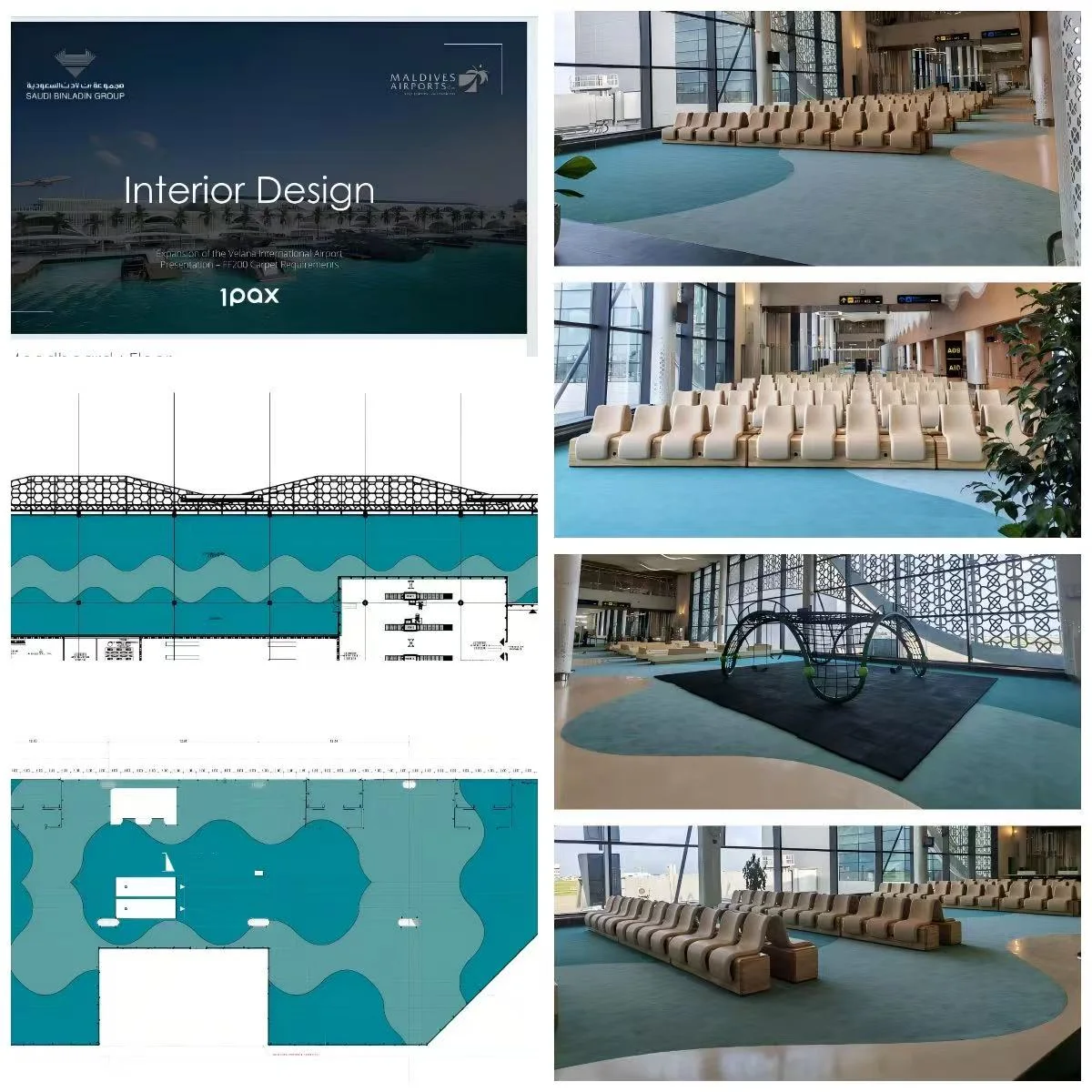
For the terminal expansion at Velana International Airport in the Maldives we produced a custom wave-motif flocked floor for the gate seating areas. The design started as plan drawings with the project team: two blues in a wave that follows the rows of seats. In the finished terminal the textile floor sits under the seating, and the walkways around it are a hard floor. Passengers walk on the hard surface and wait on the soft one.
That split is the useful lesson. It puts the textile floor where its benefits are felt (quiet underfoot, warm, a place-specific design) and keeps the heaviest wheeled routes on a surface made for them. We have also supplied flooring for the passenger boarding bridges at a major South Korean airport, and about 1,000 m² at Zhengzhou Airport in China. More projects are on the projects page.
Noise: what the floor can and cannot do in a terminal
A terminal has two noise problems. Impact noise is footsteps, roller bags on the floor and dropped items. On a hard floor it is loud where it happens and it travels through the structure. A textile surface is markedly quieter underfoot and cuts impact sound to the floor below: flocked flooring is tested at ΔLw 21 dB.
Reverberation is sound lingering in a large hall, the reason announcements are hard to understand. It is controlled by ceilings, wall panels and soft furnishings, not by the floor, and a supplier who promises otherwise is overselling. The longer explanation is in what acoustic flooring actually does.
Wayfinding and a sense of place
Most terminals look alike. Because flocked flooring is digitally printed, the floor can help people find their way and tell them where they have landed: a colour for each pier, gate numbers at the holdroom, a line that leads to the lounge, or a motif from the local landscape, like the Velana wave. There is no tooling cost, so a design made for one airport costs the same to produce as a stock pattern. See how custom printed floors are made.
Cleaning and repair in a building that never closes
Cleaning happens on night shifts around passengers. The surface is a short, dense flock on a sealed backing, so spills stay on top: it is vacuumed daily and wet-mopped, extraction-cleaned or steam-cleaned periodically, with standard equipment. The routine is in how to clean flocked flooring.
Repair is easier in tile format: a damaged area at a gate is lifted and replaced from spare stock overnight instead of closing a zone. Order a few percent of spare tiles from the same production batch and keep them on site so a replacement matches. Installation is bonded to a level, dry and sound subfloor with adhesive and needs no underlay; see the installation and subfloor page.
A specifier’s checklist
- Draw the zoning plan first: hard floor for main walkways, trolley lanes, baggage reclaim and entrances; textile where people sit and wait.
- Ask for reaction to fire to the standard your airport authority requires, for the batch supplied.
- Ask for slip resistance (EN 13893 or your local standard) and impact sound reduction (ΔLw); treat hall reverberation as a ceiling specification.
- For any zone with regular trolley or roller-bag traffic, ask for wear test data for the product and batch. We do not hold a castor or rolling-load test, and will say so.
- For boarding bridges, check the bridge manufacturer’s requirements for floor finishes.
- Specify entrance matting at every door from outside.
- Order spare tiles from the same batch for overnight repairs.
- Plan delivery against phased construction: stock designs typically take a few weeks to produce, custom prints around 4 to 8 weeks, then sea freight and customs.
Buying for an airport project
Our standard minimum is 500 m² per colour, because each colour is a separate production run; airport packages are usually well above that. Custom colours and custom prints need the full 500 m². Samples are free and the buyer pays the courier: send us your courier account number, or we quote the freight before we ship. For a tender, ask us for the technical data sheet; the dated test report for the batch supplied is issued with the order. Lead times, shipping terms and documents are summarised on our page for contractors.
Ask about your airport project
FAQ
What is the best flooring for an airport terminal?
No single floor suits a whole terminal. Main circulation routes, check-in and baggage reclaim take the heaviest wheeled traffic and wet shoes, and are usually a hard floor such as terrazzo, stone or resilient sheet. Gate seating areas, lounges, offices and boarding bridges are where people sit and wait, and where a textile floor earns its place by being quieter underfoot and warmer. Flocked flooring is a textile option for those zones: dense nylon 6.6 on an impervious backing, so it can be wet-cleaned on a night shift, and it can be printed with wayfinding or a design for the place.
Is carpet a good idea in an airport?
In the right zones. Textile floors are common in gate holdrooms, lounges and back-of-house offices because they make a large hard space quieter underfoot and more comfortable to wait in. The usual objection is hygiene: conventional carpet absorbs spills and is slow to clean. Flocked flooring has an impervious backing, so liquids stay on the surface and it can be wet-mopped or extraction-cleaned. Main walkways and baggage halls are normally kept hard.
Will flocked flooring cope with luggage trolleys and roller bags?
We cannot give you a rating for that. We do not hold a castor-chair or rolling-load wear test (such as ISO 4918) for this product, so we do not quote one. What we can say is where it has been installed: at Velana International Airport the flocked floor sits in the gate seating areas, and the main walkways around it are a hard floor. That is the zoning we recommend. If a zone will see heavy trolley traffic, ask us for wear data for the batch, or keep that route hard.
What fire rating does airport flooring need?
It depends on the country and the airport authority, and terminals are often held to stricter requirements than offices, so check each zone with the fire engineer. BON flocked flooring is classified Bfl-s1 to EN 13501-1 (SGS). ASTM E648 / NFPA 253 data is available on request, and the dated report for the batch supplied is issued with the order. For boarding bridges, check the bridge manufacturer’s requirements for floor finishes as well.
Can the floor carry wayfinding or a design for the airport?
Yes. Flocked flooring is digitally printed, so zone colours, gate numbers, directional lines or a motif from the place can be printed into the floor with no tooling cost. At Velana International Airport the gate areas carry a wave motif designed with the project team.
Has BON supplied flooring to airports?
Yes: custom wave-motif flocked flooring for the gate seating areas at Velana International Airport in the Maldives, flooring for the passenger boarding bridges at a major South Korean airport, and about 1,000 m² at Zhengzhou Airport in China.
Free PDF
Get the Flocked Flooring Buyer’s Guide
Construction, certifications, customisation options, lead times and what really drives cost. Leave your email and we’ll send the guide over.