
Healthcare & Aged-Care Flooring: What to Specify and Why
June 2026 · 8 min read · by BON Flocked Flooring
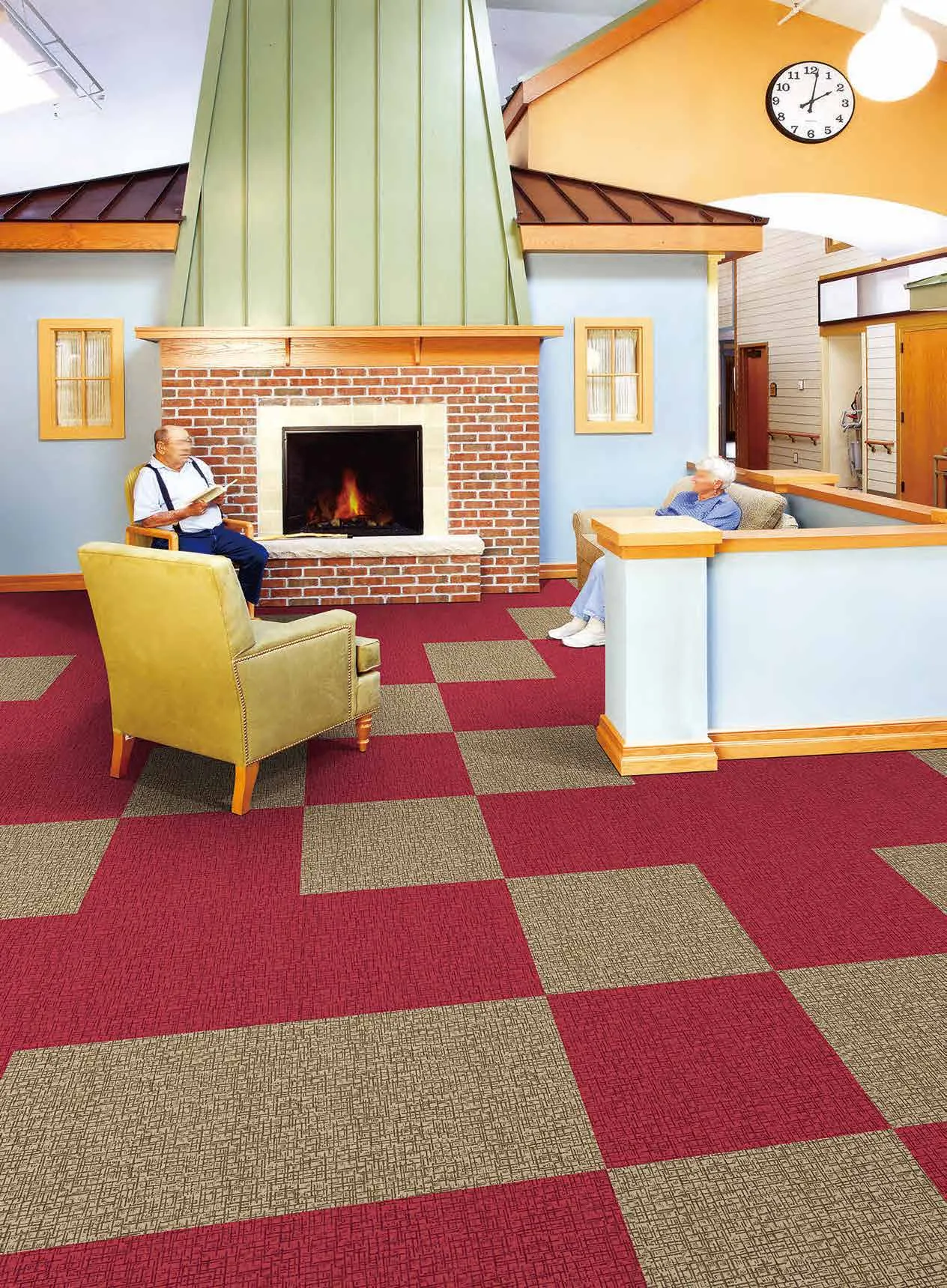
No flooring brief is harder than a healthcare or aged-care brief. Infection control says “hard, sealed, disinfectable.” Fall prevention says “soft and grippy.” Residents and families say “warm and homely, please — this is where someone lives.” And the facilities manager says “whatever it is, it gets cleaned every day and has to survive wheelchairs for ten years.” Most floors satisfy one side of that argument by failing the other. This guide walks through the six requirements, how the usual options score, and the test data worth demanding before anything goes on a tender.
The six requirements of a care-environment floor
Infection control
Fluids must not soak in; the floor must take daily wet cleaning, extraction or steam, and disinfection protocols.
Slip & fall safety
Slip-resistant underfoot for residents and staff — and forgiving if a fall does happen.
Acoustics
Trolleys, footsteps and voices echo on hard floors; quiet floors measurably calm wards and corridors.
Warmth & dignity
Aged care is someone’s home. Residents notice a floor that feels warm and domestic, not institutional.
Dementia-friendly design
Low pattern contrast, no glare, consistent tones between spaces — the floor must not read as steps or holes.
Durability & maintenance cost
Wheelchairs, walking frames, beds and hoists, every day for years — without matting, staining or fading.
How the usual options score
| Floor | Where it wins | Where it fails the brief |
|---|---|---|
| Ordinary carpet | Warm, quiet, familiar | Soaks up fluids and odours; fails infection control; wears in wheeled traffic |
| LVT / vinyl / rubber | Hygienic, easy to disinfect | Noisy, cold, hard on falls; can glare — a known issue in dementia design |
| Flocked flooring | Warm and quiet like carpet, yet impervious, washable and slip-resistant like a resilient floor | A premium textile floor — specified where the brief demands both sides at once |
For the full three-way comparison across all commercial criteria, see flocked tiles vs carpet vs LVT.
Why flocked flooring keeps getting specified for care
Flocked flooring is a dense layer of upright nylon 6.6 fibres — around 80 million per square metre — bonded to an impervious backing. That construction answers the healthcare contradiction directly: the surface feels like a warm, quiet textile, but nothing soaks through, so it wet-mops, extraction-cleans and steam-cleans like a resilient floor. On the points a care specifier actually has to defend, the independent numbers are:
- Slip — EN 13893 dynamic coefficient of friction 0.45 (SGS), above the 0.30 low-slip threshold;
- Hygiene — impervious backing; antimicrobial activity tested to AATCC 174 (Intertek); washable and steam-cleanable;
- Indoor air — formaldehyde not detected, GB 18587 (SGS) — relevant for residents who spend all day indoors;
- Acoustics — impact sound reduction ΔLw 21 dB (SGS): trolleys and footsteps are markedly quieter underfoot and carry far less to the floor below (see what acoustic flooring actually does);
- Fire — classified Bfl-s1 to EN 13501-1 (SGS), the class commonly demanded in public and care buildings.
Full details and the documentation we issue per project are on our certifications page.
The dementia-design angle most floors can’t offer
Dementia-friendly guidance is specific about floors: low pattern contrast (strong contrast can be perceived as a step or a hole), no glare or sparkle (a known problem with shiny resilient floors), and consistent tone from room to corridor so thresholds don’t read as barriers. Most flooring ranges force you to pick the nearest catalogue item. Flocked flooring is digitally printed, so contrast, pattern scale and colour temperature are set precisely to the design guidance — and kept consistent across every space in the scheme. For memory-care projects that control is the difference between a floor that complies and a floor that fights the brief.
Where it’s already running
This isn’t theoretical. BON flocked flooring runs in aged-care homes in China (a 4,000 m² project) and Australia, alongside hospitals, schools and public buildings — sectors where the specification was won on exactly the points above. Sector references are available for serious enquiries; see healthcare & aged care applications and our project write-up.
A specifier’s checklist
- Ask for the slip test report (EN 13893 or pendulum) — not just the word “anti-slip”;
- Confirm the backing is impervious and the floor tolerates your actual cleaning regime (wet, extraction, steam, disinfectants);
- Ask for fire classification (EN 13501-1 / ASTM E648) issued for the supplied batch;
- For dementia units, review pattern contrast and glare against your design guidance — and ask whether the supplier can adjust them;
- Check emissions (formaldehyde / VOC data) for enclosed, always-occupied spaces;
- Ask for care-sector references, not just any commercial project.
FAQ
What flooring is best for aged-care and nursing homes?
The brief usually demands five things at once: hygienic and fluid-proof for infection control, slip-resistant for fall prevention, quiet, warm and non-institutional for resident wellbeing, and washable on a daily cleaning regime. Hard floors meet the hygiene points but fail on warmth, noise and fall injury; ordinary carpet is warm but soaks up fluids. Flocked flooring — a dense nylon 6.6 pile on an impervious backing — is one of the few surfaces that meets all five, which is why it keeps being specified for aged care.
Is flocked flooring hygienic enough for healthcare?
Yes. Because the backing is impervious, spills and fluids stay on the surface instead of soaking into the floor, so it can be wet-mopped, extraction-cleaned or steam-cleaned like a resilient floor. BON flocked flooring has been tested for antimicrobial activity (AATCC 174, Intertek) and formaldehyde was not detected in SGS testing to GB 18587 — documentation is issued per project and batch.
Does soft flooring really reduce fall injuries?
A slip-resistant textile surface helps twice: it lowers the chance of a slip in the first place (BON flocked flooring tested to EN 13893 with a dynamic coefficient of friction of 0.45 — above the 0.30 low-slip threshold), and a cushioned surface is more forgiving than tile or vinyl when a fall does happen. For aged-care corridors and bedrooms that combination matters.
What flooring is recommended for dementia care?
Dementia-design guidance favours floors with low pattern contrast, no glare or sparkle, and consistent tone between rooms — high-contrast patterns can be read as steps or holes. Because flocked flooring is digitally printed, contrast and pattern scale can be controlled precisely to suit dementia-friendly palettes, rather than choosing from a fixed catalogue.
Can you provide test certificates for healthcare tenders?
Yes. BON flocked flooring is independently tested: reaction to fire Bfl-s1 to EN 13501-1 (SGS), slip EN 13893 CoF 0.45 (SGS), impact sound reduction ΔLw 21 dB (SGS), formaldehyde not detected to GB 18587 (SGS) and antimicrobial activity to AATCC 174 (Intertek). The dated report for your specified product and batch is issued with the order.
Free PDF
Get the Flocked Flooring Buyer’s Guide
Construction, certifications, customisation options, lead times and what really drives cost. Leave your email and we’ll send the guide over.