
Daycare, Nursery & Kindergarten Flooring: What to Specify
August 2026 · 8 min read · by BON Flocked Flooring
The short answer
A childcare floor has to be soft, genuinely washable and quiet — and most floors give you only two of the three. Vinyl and rubber disinfect easily but are cold, hard and loud. Ordinary carpet is warm and quiet, but a spill or an accident soaks through the backing and the stain and smell stay. Flocked flooring is a dense nylon 6.6 textile surface on an impervious backing, so it feels warm and cuts footfall noise (ΔLw 21 dB, ISO 10140-1 / 717-2, SGS) while liquids stay on the surface and wet-mop, extraction- or steam-clean away. It is tested to Bfl-s1 for fire (EN 13501-1), to a slip resistance of 0.45 (EN 13893) and for antimicrobial activity (AATCC 174, Intertek), and formaldehyde is not detected (GB 18587).
What it is not: it is not impact-attenuating safety surfacing. Under climbing frames and other fall-height equipment you still need dedicated safety matting to the relevant standard. It also reduces footfall noise, not room echo — that is a ceiling and wall job.
Few floors get treated as badly as a nursery floor. It is spilled on, fallen on, crawled on, dragged across and cleaned every single day — and the people using it are small, loud and put their hands on everything. Most childcare settings end up compromising: a hard floor that is easy to disinfect but cold and noisy, or a soft floor that is comfortable until the first accident soaks into it. This guide sets out what the floor actually has to do, how the usual options fare, and the test data worth asking for.
Five things a childcare floor must survive
Spills and accidents, daily
Drinks, paint, food, toilet training. The floor must not absorb any of it — an impervious backing means it stays on the surface and wipes or wet-mops away.
Children who fall
Toddlers fall constantly. A warm, cushioned, slip-resistant textile surface is kinder than vinyl or tile (ours: EN 13893, CoF 0.45). Dedicated safety matting still belongs under climbing equipment.
Noise
A room of children is exhausting on a hard floor. A textile surface is quieter underfoot and cuts impact noise to the floor below (ΔLw 21 dB).
Relentless traffic
Chairs, trolleys, scooters, a hundred small feet. The floor has to look acceptable for years, not months — dense short pile does not mat the way cut-pile carpet does.
Cleaning regime & air quality
Cleaned every single day, often disinfected. And children breathe at floor level — low-emission matters (formaldehyde not detected, SGS to GB 18587).
How the options compare
| Floor | Where it wins | Where it falls short |
|---|---|---|
| Vinyl / rubber / epoxy | Hygienic, easy to disinfect, hard-wearing | Cold, hard on falls, and loud — a noisy room stays noisy |
| Foam mats / soft play tiles | Very soft, cheap to start | Tear and curl, dirt gets into seams and under them, replaced often; not a whole-room floor |
| Ordinary carpet | Warm, quiet, comfortable | Absorbs spills and odours; the hygiene problem that gets it removed from childcare settings |
| Flocked flooring | Warm, quiet, slip-resistant AND impervious — wet-cleanable daily; digitally printable for play zoning | A premium textile floor; safety matting still needed under climbing equipment |
Why flocked flooring fits childcare
Flocked flooring is around 80 million short nylon 6.6 fibres per square metre, bonded electrostatically to an impervious backing. In a nursery that construction does two opposite jobs at once: the pile gives the warmth, quiet and slip resistance children need on the floor, while the sealed backing means a spilled drink or an accident sits on top and can be cleaned away — daily, with a mop, extraction machine or steam. That is the compromise childcare settings usually have to make, removed.
The independently tested numbers behind it: slip resistance EN 13893, CoF 0.45; impact sound reduction ΔLw 21 dB (ISO 10140-1 / 717-2); formaldehyde not detected to GB 18587; antimicrobial activity tested to AATCC 174 (Intertek); reaction to fire Bfl-s1 to EN 13501-1. Full detail on the certifications page.
One honest limit
This is a textile floor covering, not impact-attenuating safety surfacing. Under climbing frames, slides and gym equipment you still need dedicated safety matting tested to the relevant impact standard for the fall height. For classrooms, play rooms, corridors and activity areas, it is the floor that does the rest of the job.
The design opportunity most childcare floors miss
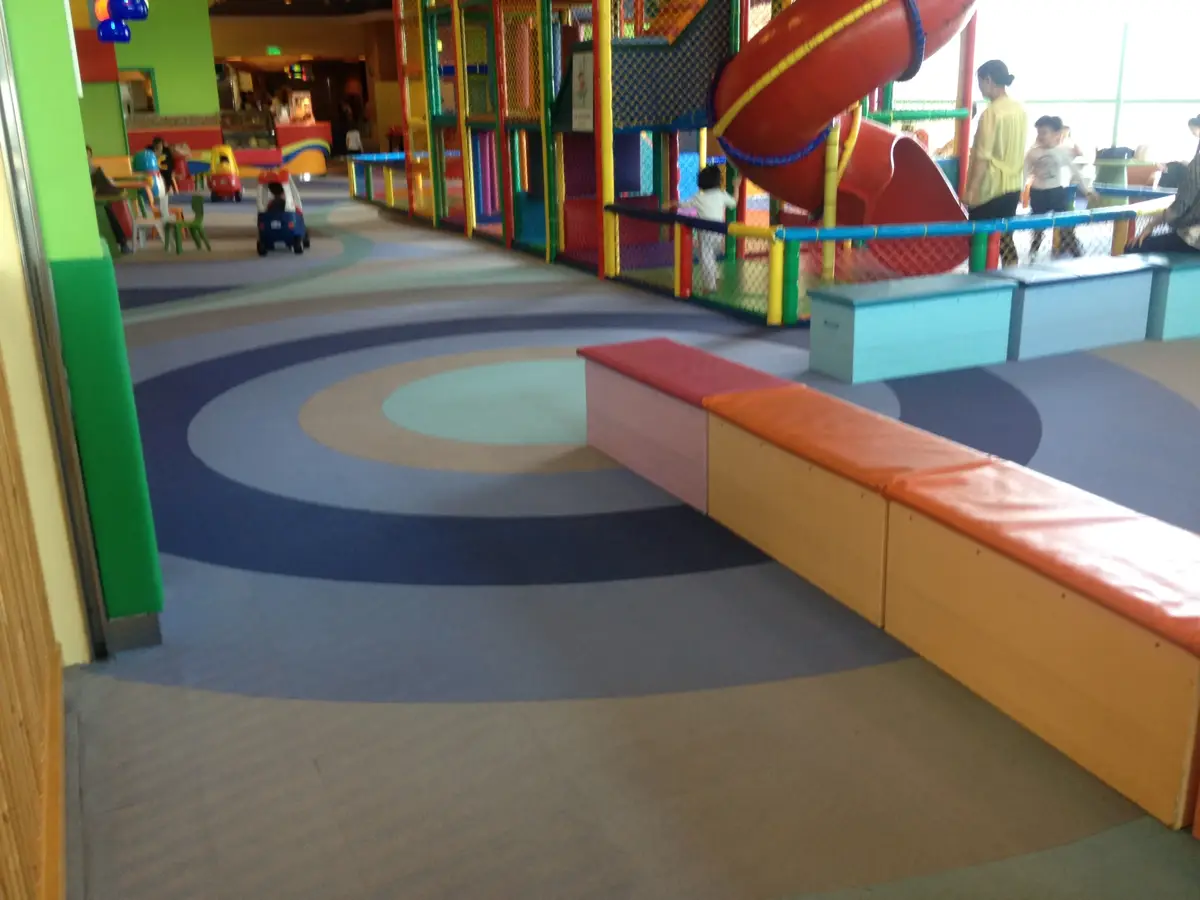
Because the surface is digitally printed, a nursery floor can be part of the learning environment rather than a grey background: colour-zoned areas, roads and tracks, numbers and letters, or a setting’s own artwork — printed into a floor that still wet-cleans and wears like a commercial one. There is no tooling cost, so a one-off design for a single setting is as economic as a stock pattern. See how custom printed floors are made.
A specifier’s checklist
- Confirm the backing is impervious — the single most important property for a childcare floor.
- Ask for slip resistance (EN 13893 or local equivalent) and reaction to fire for the batch supplied.
- Ask for low-emission / formaldehyde data — children spend the day at floor level.
- Check the cleaning methods it is rated for: wet-mop, extraction, steam.
- Specify separate safety matting under climbing and play equipment.
- Decide whether custom print (zoning, play layouts) is worth building into the design.
FAQ
What is the best flooring for a daycare or nursery?
The brief is unusually demanding: it has to be soft enough for children who fall, hygienic enough for spills and accidents, quiet enough that a room of children is bearable, and tough enough for constant traffic and daily cleaning. Hard floors (vinyl, rubber, epoxy) clean well but are cold, hard and noisy; foam mats are soft but tear and trap dirt; ordinary carpet is warm but absorbs everything. Flocked flooring is one of the few surfaces that answers all four — a dense nylon 6.6 textile pile on an impervious backing, so it is soft and quiet underfoot yet wet-cleanable like a resilient floor.
Is flocked flooring hygienic enough for childcare?
Yes — that is the point of the construction. Because the backing is impervious, spills, drinks and accidents stay on the surface instead of soaking into the floor, so it can be wiped, wet-mopped, extraction-cleaned or steam-cleaned on a daily routine. BON flocked flooring has also been tested for antimicrobial activity (AATCC 174, Intertek) and formaldehyde was not detected in SGS testing to GB 18587 — relevant when small children spend all day on the floor.
Is it soft enough for toddlers and floor play?
It is a textile floor — warm and cushioned underfoot rather than hard like vinyl or tile, and slip-resistant (tested to EN 13893 with a dynamic coefficient of friction of 0.45, above the 0.30 low-slip threshold). It is not a thick impact-attenuating mat, so under climbing frames or gym equipment you should still use dedicated safety matting to the relevant impact standard. For general play areas, classrooms and corridors it gives comfort without the cleaning problems of carpet.
How does it handle noise in a nursery?
A room full of children is loud, and a textile floor helps in the way a floor can: it is quieter underfoot than a hard surface, and it cuts impact and footfall noise carried to the room below — tested at ΔLw 21 dB (SGS, ISO 10140-1 / 717-2). Note that echo and voices in the room itself are airborne noise, controlled mainly by acoustic ceilings and soft furnishings; the floor is one layer of a calmer room, not the whole answer.
Can we have a custom design for a play area?
Yes. Flocked flooring is digitally printed, so a nursery can have zoning colours, play layouts, roads, numbers or its own artwork printed into the floor with no tooling cost — and it is still a cleanable commercial floor rather than a stuck-down graphic. MOQ is from 500 m².
Free PDF
Get the Flocked Flooring Buyer’s Guide
Construction, certifications, customisation options, lead times and what really drives cost. Leave your email and we’ll send the guide over.